Understand before deciding
Build subject knowledge and collect relevant information. Separate what is known from what is assumed.
 ©Meet EdVantage ↗
PURPOSE. INQUIRY. CONTRIBUTION.
Transformative Learning Projects© connects authentic real-world problems with curriculum knowledge, structured inquiry, ethical decision-making, and meaningful contribution. Six stages turn learning into evidence-based responses to the needs of people and the planet.
Explore the framework ↓Designed by EdVantage Solutions® · Grounded in authentic project-based learning
01 / THE IDEA
It is a structured way to understand a problem, investigate it, make responsible decisions, and create a response with a purpose.
The TLP Stage-Wise Project-Based Learning Framework is a six-stage educational architecture. It connects authentic real-world problems with curriculum knowledge, sustained inquiry, visible evidence and meaningful assessment.
The project is central to learning. Students build understanding while they investigate and develop their response, supported by teaching, examples and feedback at the moments they need them.
THE LEARNING LOGIC
Build subject knowledge and collect relevant information. Separate what is known from what is assumed.
Interpret findings, examine causes and trade-offs, and justify the direction of the final product.
Make a complete draft, invite critique, revise and rehearse before presenting to an audience.
02 / THE SIX-STAGE JOURNEY
Each stage has a distinct learning purpose, visible evidence and an assessment point. Open a stage to see what students do and how their learning becomes visible.
The learning sequence is protected; time and scaffolding can vary. Moving forward means demonstrating sufficient understanding and evidence, not simply finishing a worksheet.
03 / WHAT DEVELOPS ACROSS EVERY STAGE
Knowledge, inquiry, reasoning, teamwork and character grow together across the project. They are not separate extras.
Activate and build concepts, apply them to decisions and design, then explain and transfer understanding.
Ask useful questions, collect information ethically, judge its quality and defend conclusions.
Identify causes, compare options and improve a response for feasibility, quality and responsible use.
Agree roles and norms, resolve differences, coordinate tasks, rehearse and evaluate team performance.
Practice purpose, honesty, respect, consultation, responsibility, humility and service through academic work.
CHARACTER, MADE VISIBLE
The Character Education Integration Framework (CEIF) connects values with authentic actions: recording findings honestly, respecting interview participants, listening to teammates and responding constructively to feedback. Reflection helps students recognize those choices.
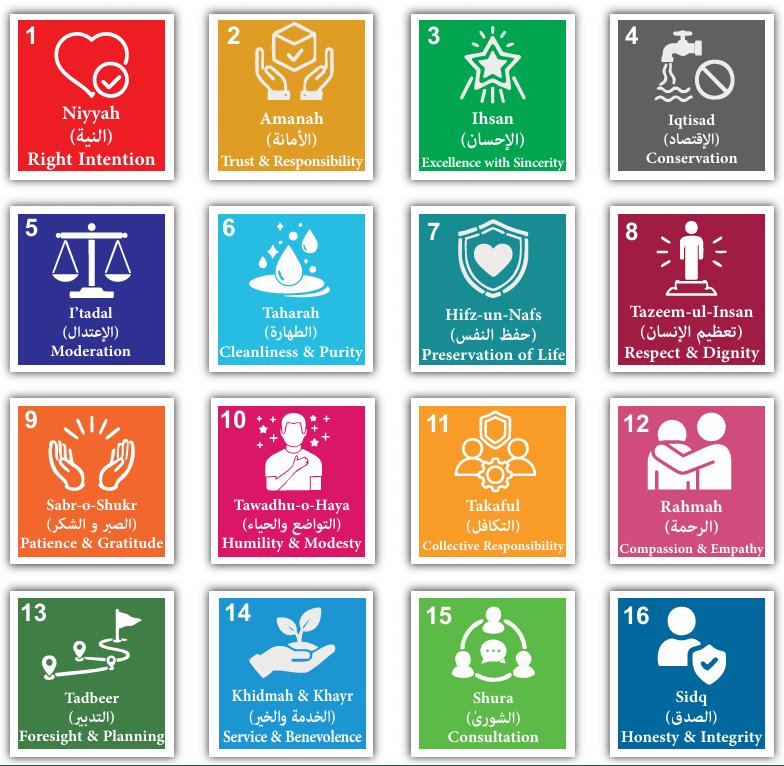
Projects select values that fit the learning task. Islamic guidance, purposeful action and reflection connect character with the decisions students actually make.
04 / EVIDENCE & ASSESSMENT
Assessment is distributed across the journey. Students, peers, teachers and reviewers contribute at the point where their feedback is most useful.
| Stage | Assessment | Who contributes | What it checks |
|---|---|---|---|
| 01 · Engagement | Student self-assessment rubric | Student | Problem understanding, product awareness and readiness to investigate. |
| 02 · Inquiry | Student reflection and peer feedback | Student and peers | Conceptual understanding, inquiry quality, ethics and recording accuracy. |
| 03 · Analysis | Mid-Project Assessment Rubric | Teacher | Evidence judgment, priorities, decisions and justification. |
| 04 · Drafting | Expert or role-based feedback sheet | Expert, teacher or role-based reviewer | Feasibility, audience suitability, ethics and improvement needs. |
| 05 · Refinement | Student reflection and peer assessment | Student and peers | Use of feedback, product improvement and presentation readiness. |
| 06 · Showcase | Final Project Evaluations Rubric | Teacher, with audience and peer evidence | The full journey, product, presentation, collaboration, values and transfer. |
A visible record of learning: research notes, recorded observations, analysis, justified choices, draft versions, feedback, revisions and reflection. The exact records depend on the project.
A review of whether the required learning outcomes and evidence are sufficient for the next stage. Activity completion by itself is not enough.
05 / IN THE CLASSROOM
Agency does not mean leaving students to work without instruction. Teachers provide concepts, examples, tools, boundaries and timely feedback. Students make meaningful decisions about questions, methods, priorities, product features, roles and revisions.
Each subject must contribute a concept, skill, standard or learning outcome that students actually use. Mathematics may help interpret evidence; language may help communicate a recommendation. Links are chosen for their contribution to the problem.
A Project Management System (PMS), LMS or structured paper portfolio can record and review evidence. The learning expectations remain the same in low-tech and digitally supported classrooms.
Change the theme, driving question, duration, inquiry methods, audience and product format. Retain inquiry before analysis, analysis before product design, and draft, feedback, refinement and public sharing.
LOCAL INQUIRY / GLOBAL RELEVANCE
Across TLP projects, students explore interconnected challenges, make responsible decisions, and develop practical green skills for sustainable living. Education for Sustainable Development (ESD) is the learning approach; the Sustainable Development Goals (SDGs) connect that learning to shared global priorities.
UNESCO describes ESD as developing the knowledge, skills, values, attitudes, and behaviors needed to make responsible choices for the environment, economy, and society. SDG Target 4.7 places education for sustainable development and global citizenship within quality education.
In TLP, students investigate real conditions, consider who is affected, examine resource use and feasibility, and develop a response they can explain and justify.
An electricity audit connects everyday habits with energy efficiency. A water investigation connects community well-being with care for shared resources. A housing design connects comfort and safety with climate-responsive choices.
Students learn to consider environmental, social, and economic dimensions together: Will it conserve resources? Who will benefit? Is it safe, affordable, and realistic?
Use subject concepts, accurate records, calculations, and source checks to understand a problem and its causes.
Practice Amanah, Shura, and Takaful through honest inquiry, shared decisions, and attention to community needs.
Compare options, justify choices, improve work through feedback, and communicate practical recommendations to an audience.
Global context: UNESCO: Education for Sustainable Development · SDG Target 4.7. The classroom connections above describe how TLP puts these ideas into practice.
SUSTAINABILITY IN THE PROJECT BOOKS
These projects place energy, water, climate, and responsible resource use at the center of learning. Each connects a real-world question with evidence, a practical final product, and an audience.
GRADE 7 / ENERGY & RESOURCE USE
Designing Smart & Low-Cost Electricity-Saving Solutions
Students investigate electricity use through observations, appliance information, interviews, surveys, and research. They calculate estimated consumption in kilowatt-hours, costs, and potential savings, then compare solutions for safety, comfort, cost, and feasibility.
Final product: An integrated Energy-Saving Action Proposal, supported by evidence, calculations, visuals, responsibilities, and implementation steps.
Global relevance: Energy-efficiency learning relates to Target 7.3; responsible resource use and everyday consumption choices connect with Targets 12.2 and 12.8.
GRADE 6 / WATER & COMMUNITY WELL-BEING
Clean, Safe, and Smart Solutions for Our Community
Students investigate local water concerns through observation, surveys, and interviews. Tables, graphs, percentages, and cause–effect reasoning help them prioritize problems and design affordable, realistic responses.
Final product: A Water Safety Solution—an awareness campaign or simple water filter prototype—shared at a Community Water Safety Awareness Day.
Global relevance: Learning about contamination prevention supports awareness relevant to Target 6.3; careful water use relates to Target 6.4, and sustainable habits to Target 12.8.
A classroom filtration prototype demonstrates a process; it does not certify that water is safe to drink.
GRADE 8 / DESIGN & SUSTAINABILITY
Smart, Sustainable and Climate-Responsive Living Spaces
Students investigate how water, air, light, materials, and layout affect daily living. Observation logs, area and volume measurements, window ratios, and research guide design choices for comfort, safety, and responsible resource use.
Final product: A Smart & Sustainable House Design—a labeled 2D or digital layout, or a 3D model—with calculations and an evidence-based design explanation.
Global relevance: Housing awareness relates to Target 11.1, resource-conscious design to Target 12.2, and climate-responsive learning to Target 13.3.
GRADE 8 / DATA & ENVIRONMENT
Predicting Change, Designing Sustainable Impact
Students organize environmental data, examine patterns in temperature, rainfall, pollution, and human activity, and use graphs and simple mathematical models to explore possible outcomes. They evaluate data reliability and the limitations of predictions.
Final product: A Climate Data Analysis Report, Prediction Model, and Sustainable Action Plan, explained through graphs, calculations, and a public showcase.
Global relevance: Climate education connects with Target 13.3; understanding risks to vulnerable communities relates to Target 11.5; informed environmental action supports learning under Target 4.7.
These are educational connections described in the project materials, not claims of measured progress against global SDG indicators. Estimated savings and proposed improvements become demonstrated impact only when implemented and checked.
CURRICULUM INTEGRATION
TLP projects cultivate skills and concepts consistent with the Pakistan National Curriculum and Cambridge curriculum frameworks. Through real-life inquiry, investigation, collaboration, communication, and problem-solving, students apply learning from multiple subjects in meaningful and integrated ways.
Each subject contributes knowledge or a skill that students actually use to understand the problem, interpret evidence, make decisions, or communicate a response. The specific subjects, domains, standards, and learning outcomes depend on the project and grade.
| Subject area | Learning domains and skill areas | How learning becomes visible |
|---|---|---|
| Science | Scientific Enquiry / Thinking and Working Scientifically; relevant concepts in energy, heat, materials, mixtures and separation, health, and the environment. | Observations, guided investigations, explanations, comparisons, and scientifically informed design choices. |
| Mathematics | Statistics and Probability / Data Handling; percentage, ratio, measurement, area and volume; mathematical reasoning and simple modeling where appropriate. | Tables, graphs, calculations, cost comparisons, estimates, and evidence-based priorities. |
| Geography / Social Studies | Human and environmental relationships; responsible use of resources; environmental change, settlements, and community well-being. | Cause–effect analysis, consideration of local conditions, resource-use decisions, and practical community recommendations. |
| English / Urdu | Reading and Critical Thinking; informative, explanatory, and persuasive writing; oral communication, speaking and listening. | Research notes, interviews, discussions, proposals, awareness messages, presentations, and responses to feedback. |
| History | Historical Enquiry and Interpretation; chronology; comparison of experiences, lifestyles, and changes over time, where relevant to the project. | First-hand accounts, organized narratives, comparisons across generations, and responsible use of interview evidence. |
| ICT / Computer Science | Digital skills, information literacy, digital citizenship, and appropriate tools for organizing and communicating information. | Organized digital records, charts, audio or visual communication, source acknowledgment, consent, and privacy-aware sharing. |
Students use concepts to investigate, analyze, design, and explain. A graph supports a comparison; a calculation tests an estimate; a written recommendation connects a proposed action with its evidence.
Critical thinking, communication, collaboration, and creativity are practiced throughout the six stages. CEIF embeds purpose, honest recording, consultation, responsibility, and structured reflection within the academic work.
This overview summarizes connections used across the books. Project-specific mappings guide grade-level teaching; not every project uses every subject or domain.
GLOBAL RELEVANCE / CONTEXT-RESPONSIVE LEARNING
The student books draw on Global Citizenship Education principles: understanding interconnected issues, respecting different perspectives, and considering how choices affect others. Students practice these through ethical inquiry and public communication.
The books reference P21 and OECD guidance alongside ESD and GCED. Within projects, students practice critical thinking, collaboration, creativity, communication, and responsible decision-making through visible tasks and evidence.
Water availability, energy use, housing conditions, and environmental risks differ by place. TLP keeps the six-stage learning progression while allowing the problem, evidence sources, resources, audience, and final product to respond to local needs.
Students explain what their evidence supports, acknowledge limitations, and distinguish proposed benefits from observed results. Public sharing invites questions and helps connect learning with future action.
CONTENT FOUNDATIONS
Framework language and learning progression are drawn from the TLP Stage-Wise Framework and Stage Clearance Model. Curriculum and project examples are drawn from the Grade 6 and Grade 8 student books and Project 701 — Energy Sense. Character integration follows the Character Education Integration Framework.
International context: UNESCO ESD · ESD learning objectives · UN Sustainable Development Goals. These connections do not imply endorsement or accreditation.
06 / DESIGN STANDARDS
Different projects. Consistent expectations for meaningful learning.
07 / FOUNDATIONS & ORIGINAL CONTRIBUTION
The framework draws on established principles of authentic project-based learning: a challenging problem, sustained inquiry, disciplinary knowledge, student voice, collaboration, critique, a public product and reflection.
Its original contribution is the specific six-stage architecture: explicit analysis and decision-making, a separation between drafting and refinement, a distributed assessment ladder, embedded character development and visible evidence for progression.
The framework describes its development as retrospective-deductive formalization: starting from authentic PBL principles and deriving the learning movements, evidence expectations, assessment points and teacher–student responsibilities.
EdVantage Solutions does not claim ownership of project-based learning itself. This site explains its TLP architecture; it does not claim independent validation of outcomes or endorsement by the organizations referenced.
DEVELOPED BY EDVANTAGE SOLUTIONS®
Transformative Learning Projects© is an educational framework developed by EdVantage Solutions in Karachi, Pakistan. It supports the design, facilitation and assessment of authentic project-based learning.
For school implementation, training and institutional inquiries, contact info@edvantageonline.org, or explore the organization’s educational work.
Visit EdVantage Solutions ↗